
🎯 Quick Takeaways
- ✅ A good night routine on a budget costs almost nothing. The parts that actually help you sleep (a set wind-down time, dim warm light, the phone out of reach) are free
- ✅ The phone is the whole fight. Lying in bed scrolling SHEIN and TikTok at midnight is what wrecks the wind-down, and moving the phone across the room is free
- ✅ Ten minutes of prep the night before, a quick tidy plus tomorrow’s outfit and coffee, buys morning-you a calm start for zero dollars
- ✅ Warm light does most of the cozy work. One cheap lamp instead of the overhead is the closest thing to a free upgrade there is
- ✅ Cheap tea, a library book, and a $4 candle get you the whole “aesthetic night routine” feeling without the aesthetic price tag
- ✅ Start with one step this week, not all fifteen. One small thing you actually keep beats a perfect routine you quit by Wednesday
📑 Table of Contents
- Where to start with a night routine on a budget
- Pick a wind-down time and protect it
- Put your phone across the room
- Do a 10-minute tidy so morning-you isn’t ambushed
- Write tomorrow’s short to-do list
- Make a cheap cup of herbal tea
- Turn off the overhead light, use one warm lamp
- A simple, cheap skincare wind-down
- Free stretch or a short YouTube yoga video
- Read a real book from the library
- Pick no-spend evening entertainment
- Prep coffee and your outfit for the morning
- A two-minute gratitude or worry dump
- Light a cheap candle, make the room smell nice
- Set a screen curfew you can actually keep
- Keep it short and repeatable
- The parts I get wrong
- What actually changed
- Questions people ask me
My old nights went like this. I’d tell myself I was going to bed at eleven, then I’d get horizontal, pick up my phone “just for a second,” and resurface at 1am somewhere deep in a SHEIN cart I wasn’t going to check out and a stranger’s four-part storytime I didn’t care about. Eyes burning. Brain wired. Then I’d sleep badly, wake up cranky, and start the whole day already behind. I built a night routine on a budget because I was sick of that, and because I couldn’t afford the version of “self-care night” the internet kept selling me, all bath bombs and $50 silk pillowcases and a skincare fridge, on a college budget with a Costa Rica trip fund I’m not allowed to touch.
Here’s what kept me from starting for so long. Every “cozy night routine” I saw looked like it cost a paycheck. The matching pajama set. The nice diffuser. The gua sha, the collagen tea, the seven-step routine in amber glass bottles. It read like calm you had to purchase, and I didn’t have it, so I figured a peaceful night just wasn’t a broke-person thing.
Turns out the calm was never in the stuff. Almost everything that actually settled my nights down was free or nearly free. The pretty products were set dressing the whole time.
So here’s the real version. The cheap, slightly boring, actually-repeatable one I’ve kept.
Where to start with a night routine on a budget
The first mistake, and I made it hard, is trying to buy the wind-down before building it. You see the aesthetic, you decide the candle and the tea and the little journal ARE the routine, so you spend $60 on cozy-night props and then feel like a fraud when you’re still doom-scrolling at midnight in the glow of a candle you paid too much for. The stuff doesn’t wind you down. You do.
The place to actually start with a night routine on a budget is to find the one thing that keeps you up, and fix only that first. For me it was the phone, one hundred percent. For you it might be the second-wind chores at 11pm, or the coffee you drank at 4, or the fact that tomorrow feels like a threat because nothing’s ready for it. You don’t need fifteen steps on night one. You need to catch your single worst evening habit and gently retire it. This is the same one-thing-at-a-time approach that runs through my morning routine on a budget, just aimed at the other end of the day.
I keep writing “night routine” but the honest word is “landing” — it’s just how I try to land at the end of a day instead of crashing. That’s the whole thing. Not a performance for anyone. Just a handful of cheap, repeatable moves that tell my brain the day is over and it’s allowed to stop bracing.
Night routine on a budget: the 15 steps
1. Pick a wind-down time and protect it
This is the free foundation the rest of it sits on, and it’s the one I fought hardest. Pick a time, any realistic time, when the day is officially closing. Not lights-out, just the moment you stop being productive and start slowing down. Mine is around 10pm. After that, no new tasks, no starting the dishes, no opening my laptop to “quickly” fix one thing that becomes forty minutes.
The reason it matters is that your body reads consistency as safety. When wind-down happens at wildly different times every night, your brain never gets the memo that it’s allowed to power down, so you lie there wired. Picking a rough time and mostly sticking to it is the single cheapest thing on this whole list, because it costs exactly zero dollars and a little bit of stubbornness. Some nights I miss it. Most nights, if I’ve told myself “10pm, we stop,” I actually stop.
Pick a wind-down time and defend it. It’s completely free, and a consistent slow-down signal does more for your sleep than anything you could buy.

2. Put your phone across the room
If you do only one thing off this list, do this one. The phone is the entire battle. Everything else is small compared to the forty-five minutes of blue light and comparison and one-more-video that the phone steals from your night while you’re lying there thinking you’re relaxing. You are not relaxing. You’re getting activated.
So I charge my phone across the room now, on the little dresser by the door, not on my nightstand. This is the same habit I built for my mornings, and it turns out it fixes both ends of the day at once, because if the phone isn’t within arm’s reach I can’t scroll myself awake at midnight and I can’t scroll myself late at 7am. The distance is the trick. Having to physically get up and cross a cold floor is just enough friction to break the reach-for-it reflex. If you use your phone as an alarm, buy a $6 alarm clock, which is cheaper than the sleep you’re losing. A big part of why this works for me is the same reason covered in my piece on how to stop impulse buying: the late-night scroll and the late-night SHEIN cart are the exact same loop, and distance kills both.
Charge your phone across the room, not by your bed. It’s free, it takes the temptation out of reach, and it’s the highest-impact change here by a mile.
3. Do a 10-minute tidy so morning-you isn’t ambushed
There’s a specific misery to walking into a messy kitchen at 7am when you’re already running late, and a quick tidy the night before deletes it for free. Ten minutes, a timer, whatever is worst. The dishes in the sink, the clothes on the chair, the counter chaos. Not a deep clean. Just enough that morning-you doesn’t walk into a scene.
My apartment is small, so ten minutes genuinely covers it, and there’s something about doing it as part of winding down that feels less like a chore and more like closing up a shop for the night. I put on one song, do a lap, and stop when the song ends. The payoff lands the next morning every time, when I stumble out and the place looks like a person who has it together lives there, even though that person was too tired to floss the night before. Future-you is a real person and she is tired. Be nice to her.
Spend ten minutes putting the worst of the mess away. It costs nothing and it hands tomorrow-morning-you a calm start instead of an ambush.
4. Write tomorrow’s short to-do list
A lot of the reason I couldn’t fall asleep was that my brain kept running tomorrow’s checklist on a loop, terrified I’d forget something. The fix is stupidly cheap: a pen and whatever paper is nearby. I write down the three or four things that actually have to happen tomorrow, and the second they’re on paper my head stops rehearsing them.
Keep it short. This is not a life-planning session, it’s a brain dump so the worries have somewhere to live that isn’t your skull at 12:40am. Three things, five at most. Class at 9, email the professor back, move $20 to the Ally account, buy oat milk. Whatever it is, out of your head and onto the page. I keep a cheap notebook on my nightstand next to the lamp for exactly this, and it has done more for my sleep than any supplement I was ever tempted to buy. The list also means I wake up already knowing the plan instead of inventing it in a panic, which is half the battle the next morning too.
Dump tomorrow’s short list onto paper before bed. It gets the worries out of your head so you can actually sleep, and it costs a pen.
5. Make a cheap cup of herbal tea
This is the small ritual that flips the switch for me, and it costs about two dollars a box. A warm, caffeine-free drink signals to your body that the day is winding down, and the act of making it, the kettle, the waiting, the warm mug in your hands, is its own little pause. You can’t rush a hot drink. That’s kind of the point.
I buy a $2 box of lavender tea at the Aldi on Route 9, nothing fancy, and I drink it out of a chipped orange mug I thrifted for basically nothing, and the two of those together feel more like self-care than any $8 latte ever did. Chamomile, peppermint, “sleepytime” blends, whatever you like, as long as it’s caffeine-free so you’re not undoing the whole point. If you want to make it feel special without spending more, that’s what the nice mug is for. A cheap drink in a mug you love reads as a treat, which is a trick I lean on all over my cheap self-care ideas.
Make a cheap, caffeine-free cup of tea. The warmth and the little ritual of it tell your brain to slow down, for about two dollars a box.
6. Turn off the overhead light, use one warm lamp
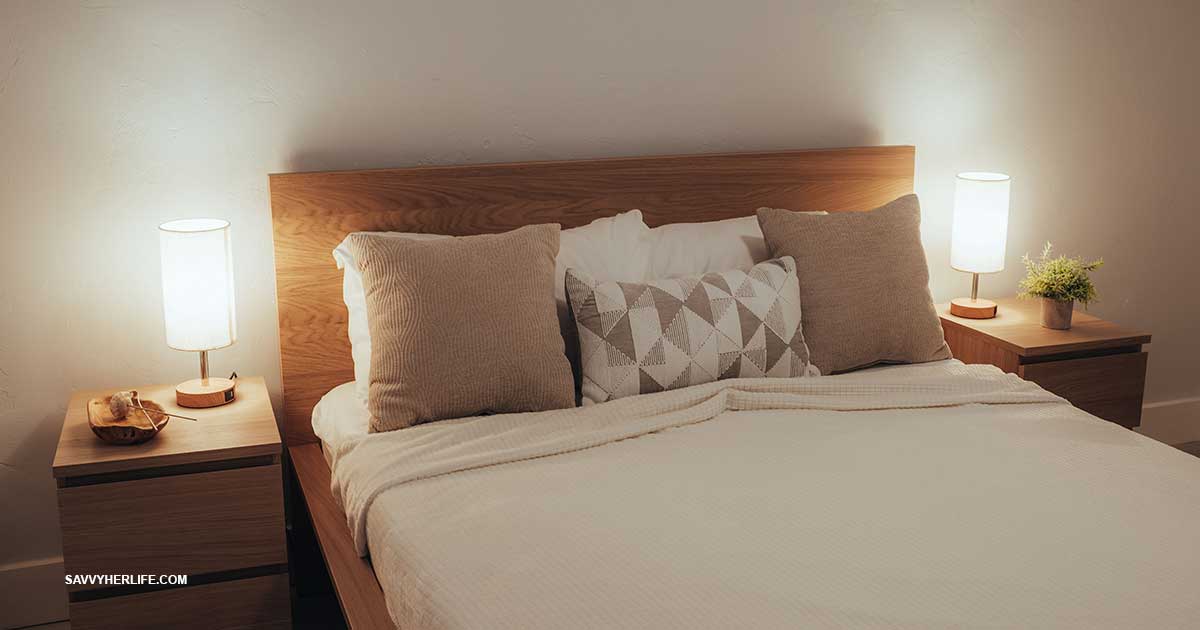
Bright overhead light at night is quietly wrecking your wind-down, because it’s basically telling your brain the sun is still up. Switching it off and using one soft, warm lamp instead is the closest thing to a free cozy upgrade that exists, and it changes the entire feeling of a room in one click.
My whole apartment shifts the second I kill the harsh ceiling light and turn on the little lamp on my nightstand with a warm bulb in it, around 2700K on the box. The room goes from “study hall” to “actual evening” instantly. Warm, dim light in the hour before bed helps your body do the melatonin thing it’s supposed to do, and a cold blue-white room fights that the whole time. A warm bulb is a few dollars and lasts years, so it’s one of those tiny changes that pays off every single night. I go on about warm bulbs constantly, because they’re the cheapest mood upgrade in any room.
Kill the overhead light and switch to one warm lamp. A few dollars for a warm bulb buys you a cozier, more sleep-friendly room every night.
7. A simple, cheap skincare wind-down
You do not need the ten-step routine or the $60 serum to get the wind-down benefit of washing your face at night. Honestly the ritual matters more than the products. Warm water, a cheap cleanser, moisturizer, done. The point is the small, repeatable sequence that tells your body it’s the end of the day, not the length of your shelf.
I use a drugstore cleanser and a basic moisturizer that together cost less than one fancy bottle of anything, and the two minutes at the sink are weirdly calming, this quiet little bookend to the day. If you want one extra nice-feeling step for almost nothing, splashing your face with cool water or taking a slow minute to actually rub the moisturizer in like you mean it does the job. The whole “that girl” skincare aesthetic is mostly good lighting and expensive packaging. The actual benefit, clean skin and a calm two minutes, is basically free. Keeping it cheap and simple is exactly the spirit of my self care ideas on a budget.
Wash your face with cheap basics as a wind-down ritual. It’s the two-minute routine that signals “day’s over,” not the price of the products.
8. Free stretch or a short YouTube yoga video
A few minutes of gentle movement before bed shakes the tension out of your shoulders and helps you actually settle, and it costs absolutely nothing. No class, no membership, no mat required if you’ve got a towel or a rug. Just some slow stretching or a short bedtime yoga video off YouTube, of which there are a thousand, all free.
I do maybe five to ten minutes of “wind-down yoga” from YouTube most nights, the kind where a very calm person talks you through some floor stretches in a soothing voice, and by the end my body has genuinely let go of the desk-hunch it’s been holding all day. You don’t need to be flexible or good at it. Nobody’s watching. The goal is to move the day out of your body, not to nail a pose. Even just lying on the floor with your legs up the wall for a few minutes counts, and that one’s free and requires no video at all.
Do a few minutes of free stretching or a YouTube yoga video. It releases the day’s tension and helps you settle, and it costs nothing but the time.
9. Read a real book from the library
Swapping the midnight scroll for a few pages of an actual book is maybe the biggest single upgrade to how I fall asleep, and thanks to the library it’s completely free. A physical book, or a library ebook on the Libby app, gives your eyes and your brain something to do that doesn’t involve a bright screen firing you up.
I use the Libby app to borrow ebooks from my library for free, and right now I’m slowly working through a used paperback of “The House in the Cerulean Sea” that Maddie left at my place months ago and never asked for back, and reading a few pages under the warm lamp puts me out faster than any amount of “trying to sleep” ever did. Reading pulls you out of your own spiraling thoughts and into someone else’s story, which is exactly what a churning brain needs at night. Between the library and Libby, you never have to buy a book again, so this genuinely-relaxing habit costs zero dollars. If you read on a device, use the warmest night-mode setting you can.
Read a few pages of a real book instead of scrolling. The library and the Libby app make it free, and it settles your brain far better than a screen.
10. Pick no-spend evening entertainment
So much late-night spending happens out of boredom. You’re bored, you’re tired, you open an app, and suddenly there’s a Sephora cart or a $30 Amazon impulse you’ll regret by morning. Deciding ahead of time what your cheap, no-spend evening thing is takes the boredom-spending trap off the table entirely.
For me the go-to is a rewatch of a comfort show I already have access to, or the book, or a cheap little craft, so that when the “I’m bored, let me shop” itch shows up at 11pm, there’s already something better and free in its place. Late-night me has notoriously bad judgment, and the trip fund for Costa Rica sits at about $812 precisely because I stopped letting bored-and-tired me hold the credit card after 10pm. Have a plan for the boredom before it arrives. A comfort rewatch, a podcast, a puzzle, a phone call with a friend, anything that scratches the itch without opening a checkout page. Filling those bored hours with free things instead of a cart is the same money-saving move at the heart of my frugal living tips for beginners.
Decide on a free, no-spend evening activity in advance. It fills the bored-and-tired hours that would otherwise turn into late-night impulse buys.
11. Prep coffee and your outfit for the morning
This is the ten-minute investment that pays the highest morning dividend, and it costs nothing but a little future-thinking. Setting up your coffee and laying out tomorrow’s clothes the night before removes two whole decisions from your groggy, half-awake morning brain, which makes the start of the day dramatically less frantic.
I grind my Aldi whole-bean coffee and get the cheap frother and the orange mug lined up so that morning-me only has to press a button, and I drape tomorrow’s outfit over the chair so there’s no standing in front of the closet at 8am having a small crisis. Making coffee at home instead of grabbing a $6 one on the way to class is a real chunk of money over a month, and doing the setup the night before means I actually do it instead of caving to the cart outside the library. It’s a tiny thing that makes the whole next morning feel handled. The whole prep-the-night-before idea is a load-bearing part of a good morning, and it belongs to the night just as much.
Set up your coffee and lay out your outfit before bed. Ten minutes tonight buys you a calm, decision-free morning and saves the daily coffee-run money.
12. A two-minute gratitude or worry dump
Right before I close the notebook, I do a quick two-minute version of either gratitude or worry, depending on the kind of day it was. Three things I’m glad about, or every anxious thing currently rattling around, scribbled fast and messy. It’s free, it takes two minutes, and it stops the emotional stuff from waiting until I’m horizontal in the dark to make itself heard.
On good days it’s a quick gratitude list, which sounds cheesy and works anyway, because naming three small nice things, the tea, a text from Maddie, the fact that I moved money to savings, ends the day on a slightly warmer note. On bad or anxious days I do the opposite and just dump every worry onto the page so it stops living in my chest. Either way, two minutes of getting your head onto paper does something a scroll never will, and it costs a pen and a corner of a page. You don’t have to journal for an hour. You just have to empty your head a little.
Spend two minutes writing down gratitude or worries before sleep. It empties your head onto the page so the feelings don’t wait for the dark, and it’s free.
13. Light a cheap candle, make the room smell nice
How a room smells is a huge part of whether it feels cozy, and you absolutely do not need a $30 designer candle to get there. Scent is a fast, direct line to the “I’m safe and it’s calm now” part of your brain, and getting there costs a couple of dollars, not thirty.
I keep a cheap $4 candle going for the last hour of my night, something warm like vanilla, and lighting it has become part of the signal that the day is done. A discount-store candle, a few drops of essential oil on a cotton ball tucked near the lamp, or even a spritz of a linen spray does the same job for very little. The point is that a nice-smelling room feels cared-for and expensive, which helps your body relax, and getting there is cheap. Just, please, blow the candle out before you fall asleep, which I say as someone who has startled awake at 2am to a candle still going and my heart in my throat.
Light a cheap candle or use a little essential oil to make the room smell nice. Scent flips your brain into calm mode for a couple of dollars.
14. Set a screen curfew you can actually keep
A screen curfew is just a time after which the phone and laptop go away, and the trick is setting one you’ll actually honor instead of a fantasy one. Screens before bed mess with your sleep because the light and the stimulation keep your brain switched on when it’s trying to switch off, which is why the 1am scroll leaves you wired instead of sleepy.
Mine is a soft “no phone in the last thirty minutes,” not some heroic two-hour ban I’d break by night two. Thirty minutes is short enough that I’ll actually do it and long enough that my brain gets to downshift before I try to sleep. If willpower isn’t enough, use the free tools already on your phone, the built-in downtime or bedtime-mode setting that greys the screen out and nudges you to stop. The reason all of this matters is real science, not a vibe, and if you want to read it, here’s the CDC’s advice on healthy sleep, which is free and worth the two-minute read. Set a curfew you can keep, and let your phone’s own settings enforce it for free.
Give yourself a short, realistic screen curfew and use your phone’s free bedtime settings to hold it. Less late-night screen glow means faster, better sleep.
15. Keep it short and repeatable
Here’s the part the aesthetic accounts never tell you: a night routine you keep beats a beautiful one you quit. A two-hour wind-down with fifteen products and a whole spa production is a thing you’ll do twice and then abandon out of exhaustion. A short, boring, ten-minute version is the one that actually survives a busy week.
My real routine on a normal night is maybe four things, tea, a tidy, a few pages, phone across the room, and that’s it, because a routine has to be small enough to do when you’re tired, which is exactly when you need it most. Pick the two or three steps from this list that gave you the biggest calm-per-effort payoff and let the rest be optional extras for the nights you have the energy. Consistency is the whole game. The unglamorous, repeatable version is the one that changes your sleep, precisely because you’ll still be doing it in a month. Small enough to keep is the only rule that matters. This is the same lesson at the heart of my sunday reset routine on a budget: the reset you’ll actually repeat is worth ten you won’t.
Keep the routine short and repeatable. Two or three steps you’ll actually do beats a fifteen-step production you abandon by Wednesday.
The parts I get wrong
Because I did not get this right the first several tries, and honestly still don’t, some nights.
My first and biggest mistake was trying to do all fifteen things at once. I read a routine online, got inspired at 9pm on a Sunday, and built myself this elaborate hour-long wind-down that I completed exactly one and a half times before quitting, because it was way too much for a tired Tuesday. The routine that stuck was the tiny one I backed into later, four steps, ten minutes, done. I should have started small instead of starting perfect.
Second, I kept “resetting tomorrow” as an excuse to break the phone rule tonight. I’d tell myself I’d charge it across the room starting Monday, and then keep it on the nightstand “just for tonight” for about three weeks of tonights. The habit only stuck once I stopped negotiating with future-me and just moved the charger. Future-me, it turns out, is not more disciplined than present-me. She’s the same tired person.
Third, I still lose the screen-curfew battle more than I’d like to admit. Some nights the phone is across the room and I do my little tea-and-book thing and it’s lovely. Other nights I “just check one thing” from bed and it’s 1am again and I hate myself a little. I’ve made peace with the fact that a routine isn’t a streak you either keep perfectly or fail. It’s a default you return to. Most nights I land it. Some nights I crash. Both are allowed.
And one thing that isn’t a mistake so much as an ongoing situation I’ve accepted. During one of those 1am “aesthetic night routine” TikTok spirals, the kind where a girl with perfect lighting does a twelve-step wind-down and you become convinced you need her exact life, I bought a silk sleep mask. Twelve dollars. It was going to change everything. Except it slides straight off my face the second I roll over, so I’ve woken up with it around my neck, on the floor, and once somehow across the room, but never actually over my eyes. It lives draped over the base of my lamp now. I sort of use it as decor. It looks nice there, in the warm light, being a sleep mask that has never once helped me sleep.
What actually changed
The first thing I noticed, once the small version of this stuck, was that I stopped waking up angry. That sounds dramatic, but the old scroll-till-1am, wake-up-cranky loop had me starting basically every day already annoyed, and a cheap, repeatable night routine on a budget quietly ended that. I fall asleep faster now. I wake up feeling like a person instead of a phone that got left on all night.
The other thing that changed was the money, in a way I didn’t expect. Once the phone was across the room and I had a plan for the bored-and-tired hours, the late-night SHEIN and Sephora and Amazon spending mostly stopped, because that spending was always a symptom of the same restless scroll. That’s real money that now sits in my Ally savings and my Costa Rica fund instead of a checkout page, and it means less of it landing on the Citibank card at 24% interest, which is the most expensive way I know to buy stuff I don’t remember wanting. A calmer night turned out to be cheaper than a chaotic one, which I did not see coming.
If you take one thing from all of this, take the phone-across-the-room rule and start tonight, before you build anything else, and just see how different the next morning feels. That small, free start is the whole spirit of a night routine on a budget, because you’re a broke, tired person making your own evenings feel calm without buying a single thing to do it. The other end of the day gets the same treatment in my morning routine on a budget, if you want to keep going.
Questions people ask me
What is a good night routine on a budget?
A good night routine on a budget is mostly free things done in a consistent order: pick a wind-down time, put your phone across the room, do a quick ten-minute tidy, write tomorrow’s short list, make a cheap cup of herbal tea, switch to one warm lamp, wash your face, and read a few pages of a library book. Those steps cost almost nothing and do the actual work of calming your brain down for sleep. The expensive stuff, the silk everything and the twelve-step skincare, is optional set dressing. Start with two or three of these and keep them small enough that you’ll still be doing them next month.
How do I create a relaxing night routine without spending money?
Lean on the free stuff, because the free stuff is what actually relaxes you. Dim the lights and use one warm lamp, do some gentle stretching or a free YouTube yoga video, read a library book or a Libby ebook, and do a two-minute worry or gratitude dump on paper. A caffeine-free tea and a cheap candle add the cozy feeling for a couple of dollars a week, but you don’t strictly need even those. The relaxing part comes from dim light, no screens, and a repeatable order your body learns to trust, none of which costs a thing.
How can I fall asleep faster on a budget?
The two cheapest, most effective moves are getting the phone away from the bed and getting off screens before you lie down. Charge your phone across the room, set a short screen curfew, and swap the scroll for a few pages of a book under a warm lamp. A caffeine-free tea, a consistent wind-down time, and writing tomorrow’s list so your brain stops rehearsing it all help you drift off faster. None of it requires supplements or gadgets. Most of what keeps you awake is light, stimulation, and an un-emptied head, and all three are free to fix.
What should a simple night routine include?
Keep it to four or five things you’ll actually repeat when you’re tired. A realistic version: phone across the room, a ten-minute tidy, tomorrow’s short list on paper, a cup of herbal tea, and a few pages of a book under a warm lamp. That’s it. You can add skincare, stretching, a candle, or a gratitude dump on the nights you have energy, but the short core is what survives a busy week. A routine you keep beats a long, beautiful one you quit, so build the small version first and let everything else be a bonus.
How is a night routine different from a morning routine?
They’re two ends of the same day, and they feed each other. A morning routine is about starting the day calm and on purpose instead of frantic, while a night routine is about closing the day down so you sleep well and set the morning up. A lot of the “morning” work actually happens at night, prepping coffee, laying out clothes, writing the list, so a good night routine is half of what makes a good morning possible. I built both, and the night one made the mornings easier more than anything I do after I wake up. You can see the daytime half in my morning routine, and the weekly version in my Sunday reset.
What if I keep breaking my night routine?
Welcome, so do I. A routine isn’t a perfect streak you either keep or fail, it’s a default you keep returning to. Some nights I do the whole calm tea-and-book thing and some nights I’m scrolling at 1am hating myself, and both are part of having a routine at all. The fix isn’t more willpower, it’s making the routine smaller and removing the temptation, mainly by moving the phone out of reach so the easiest option becomes the good one. Aim to land it most nights, forgive the crashes, and just start again the next evening. Consistency over months beats perfection over a week.
One last thing
Anyway. My nights still go sideways sometimes, the phone still wins occasionally, and I’m never going to be the girl with the twelve-step wind-down and the matching pajama set. But most nights now there’s a $2 lavender tea in the orange mug, a warm lamp on instead of the harsh overhead, a few pages of Maddie’s abandoned paperback, and my phone charging safely across the room where it can’t ambush me. The silk sleep mask is still draped over the base of the lamp, still technically a sleep aid, still never once on my actual face.
Okay. I think the last thing to decide is whether that sleep mask is decor now or just a $12 lesson I keep on display. Not tonight, though. The tea’s getting cold, and I’ve got about four pages left before I’m out.
👤 About the Author
Hi, I’m Millie — a college student writing about real life on a budget, from money to self-care to making ordinary days feel a little calmer. I share what actually works when you’re broke, busy, and trying to wind down without spending money you’re saving for something better. You’ll find more honest lifestyle and budget living tips across SavvyHerLife.
This post was researched and drafted with AI assistance, then reviewed and personally edited by Millie. All stories, brand mentions, dollar amounts, and recommendations are based on real experience.