🎯 Quick Takeaways
- ✅ Real self care ideas on a budget cost almost nothing. The stuff that actually resets you (rest, a bath, a walk, quiet) is free or close to it
- ✅ You do not need the $85 spa day or the $60 Sephora haul. That’s shopping, and shopping is not the same thing as resting
- ✅ Almost every paid “treat yourself” has a cheap at-home version: the salon manicure, the studio yoga class, the expensive candle, the takeout comfort meal
- ✅ The best self-care is boring and repeatable, not a once-a-month splurge you have to earn
- ✅ Saying no, sleeping enough, and putting your phone down are completely free and do more than anything you can buy
- ✅ Start with one small thing you’ll actually keep, not a whole Pinterest self-care Sunday you’ll quit by next week
📑 Table of Contents
- Where to start with self care ideas on a budget
- Take an actual bath instead of a spa day
- Move your body for free
- Protect your sleep like it’s the whole point
- Get a library card and use it
- Do your nails at home
- Make your space smell good for cheap
- Cook one comfort meal you actually love
- Do a two-minute brain dump on paper
- Take a real break from your phone
- Make the coffee-shop ritual at home
- Go outside, it’s free
- Use the skincare you already own
- Learn to say no without guilt
- Reset one small corner of your space
- Build one tiny ritual you’ll actually keep
- The stuff I got wrong
- What actually changed
- Questions people ask me
For a long time I thought self-care was something you bought. A candle that cost more than my grocery budget for the week. A face mask set. A spa day I’d book, then dread paying for. The whole aesthetic of it, bubble baths and green juice and a robe I did not own, felt like a members-only club my bank account had not been invited to. So when I was at my most burnt out, broke, and genuinely in need of taking care of myself, I did the exact opposite: I put a $137 order in my cart at 1am and felt worse. I started looking for real self care ideas on a budget because I was tired of confusing “treating myself” with “spending money I didn’t have,” and because the spending never actually made me feel better anyway.
Here’s what took me embarrassingly long to figure out. The stuff that actually put me back together was almost never the stuff with a price tag. A hot bath. A real night of sleep. A walk with no destination. Saying no to a thing I didn’t want to do. None of it cost anything, and all of it worked better than the cart ever did.
The expensive version of self-care is mostly marketing. Somebody figured out that stressed, tired people will buy almost anything labeled “self-care,” and they were right, because I was that person handing over the card.
So this is the real list. The cheap and free things I actually reach for when I’m running on empty, most of which cost nothing and none of which require you to earn them first.
Where to start with self care ideas on a budget
The first mistake, and the one I made for years, is treating self-care as a purchase. You feel awful, so you buy something nice, get a little dopamine hit at checkout, and call it caring for yourself. Then the box arrives, the high is already gone, and you’re the same amount of tired plus a little more broke. The buying was never the caring. It just wore the costume of it.
The actual place to start is to notice what drains you and what refills you, and then do more of the cheap refilling stuff on purpose. For me the drains were obvious once I looked: not enough sleep, too much phone, saying yes to everything, and skipping meals. The things that refilled me were almost aggressively simple. Water, quiet, a walk, a bath, a real dinner. Not one of them costs anything.
I keep writing “self-care” but the honest word for most of what actually helps is “maintenance.” Boring, regular, unglamorous maintenance, the kind you’d do for a car or a plant without expecting a spa soundtrack. That reframe took the pressure off. I didn’t need a perfect Sunday ritual with crystals and a $40 bath bomb. I needed to sleep, drink water, and stop doomscrolling, mostly. A lot of this grew out of the same slow, on-purpose mindset in my frugal living tips for beginners, just pointed at my own head instead of my wallet.
Self care ideas on a budget: the 15 that actually work
1. Take an actual bath instead of a spa day
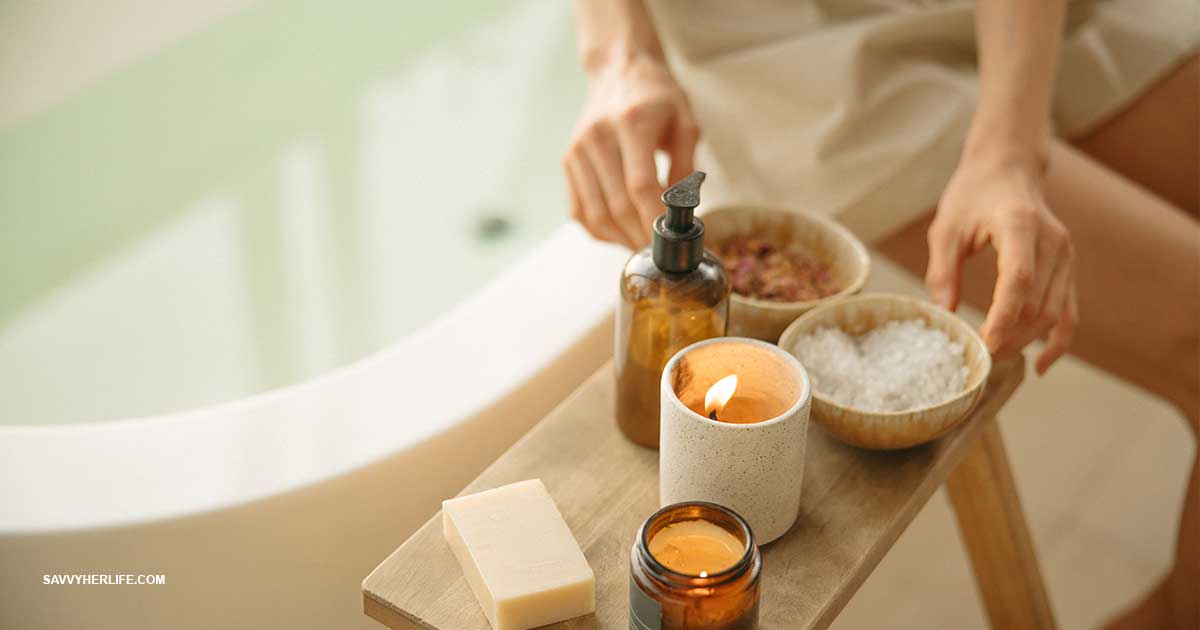
A spa day near me runs about $85 for the basic package, and I’ve done it maybe twice in my life, both times feeling faintly guilty the whole hour about what it cost. A bath in my own tub costs the price of hot water, which is basically nothing, and it does about 80% of the same thing. Warm water, quiet, and no phone is most of what the spa is actually selling you.
So I made my own version cheap. A $4 bag of Epsom salt from the drugstore lasts me a month of baths. A candle I already had. A cup of tea. That free spa playlist everybody has heard a thousand times. I lock the door, leave my phone in the other room on purpose, and just sit in the warm water until I feel like a person again. It is genuinely one of the most restoring hours I get, and it costs a few cents.
If you don’t have a tub, a long hot shower with the lights off and the same tea and the same no-phone rule gets you most of the way there. All the marble and the cucumber water was set dressing. What I actually needed was heat, quiet, and being unreachable for a little while.
2. Move your body for free
When I was most stressed I also quit moving entirely, which is exactly backwards, because moving is one of the fastest free ways to feel less awful. A boutique studio class near me is around $28 a pop, and a monthly membership somewhere nice is well over $100. I paid for exactly one month of that once, went four times, and let it auto-renew for two more months out of pure avoidance before I cancelled.
Now I move for nothing. Free YouTube yoga in my living room, the same instructor I’ve watched so many times I barely need the screen. A walk around the block when my head is loud. Dancing to two songs while dinner cooks, which is stupid and also completely works. The specific thing does not matter and the cost is zero. What matters is that moving shakes something loose when I’m wound too tight.
You do not need the membership, the outfit, or the equipment to get the mood payoff. Free workout videos cover everything from gentle stretching to sweaty cardio, so there’s no reason to pay while you’re just trying to feel better. Ten minutes counts. Ten minutes you actually do beats an hour you’re paying for and skipping out of guilt.
3. Protect your sleep like it’s the whole point
This is the free self-care nobody wants to hear, because it isn’t cute and you can’t photograph it. Sleep is the single most powerful thing I do for myself, it costs nothing, and I spent years treating it as the thing I’d get to after everything else. Which meant I never got to it, and then wondered why a bath and a candle weren’t fixing how depleted I felt.
No amount of budget self-care outruns being chronically exhausted. When I finally started guarding my sleep, going to bed at a roughly consistent time, keeping the phone out of the bed, letting myself get a real seven or eight hours, everything else got easier. My mood, my patience, my skin, my weird afternoon despair, all of it improved more from sleep than from anything I ever bought. A lot of that overlaps with my morning routine on a budget, because a calm morning basically starts the night before.
It’s free and it’s the foundation the whole rest of this list sits on. You can skip the fancy stuff. Do not skip the sleep.
4. Get a library card and use it
A library card is the most underrated free self-care tool there is, and I forgot mine existed for most of my twenties. I was buying $16 books on a whim, half of which I never finished, and paying for an audiobook subscription on top of it. Then I actually signed up for a library card, downloaded the free Libby app that connects to my local branch, and realized I’d been paying for something my taxes already covered.
Now I borrow ebooks and audiobooks straight to my phone for free. Novels for the bath. A calming audiobook for a walk. The occasional self-help book I would never have paid full price for and can now just try and return. Reading something that has nothing to do with my to-do list is one of the cheapest ways I get out of my own head, and the library makes it cost nothing at all.
Most libraries also lend way more than books now, free passes to museums, streaming for movies, sometimes even tools or craft kits. It’s a genuinely free source of the exact kind of low-key enjoyment that self-care is supposed to be, and it’s just sitting there waiting for you to remember it.
5. Do your nails at home
A salon manicure near me is $45 with tip, and a gel set is more, and I love how it feels and could not begin to justify it on my budget. So I learned to do a decent version at home, and the whole setup cost me less than a single salon visit. A base coat, a color I actually like, a top coat, and one of those $8 kits from the drugstore. That’s it, and it lasts basically forever.
The trick I figured out is that the manicure itself was never really the point. The point was the twenty quiet minutes of sitting still, doing one small careful thing with my hands, not looking at my phone because my nails were wet. It’s oddly meditative. I put on a show, take my time, and come out with hands that look nice and a head that feels calmer, for cents instead of $45.
Same logic works for a lot of the “grooming as self-care” stuff. A hair mask from the drugstore, an at-home pedicure, a face of makeup done slowly for no reason. The ritual of caring for yourself carefully is the medicine. The salon markup is optional.
6. Make your space smell good for cheap
Scent does something almost embarrassingly powerful to my mood, and it does not have to cost $30 a candle to work. I used to walk into the Bath & Body Works on Route 9 whenever I was down, the weekend of Maddie’s birthday I stood there smelling the Eucalyptus Spearmint tester about six times, and walked out $50 lighter with three candles I “needed.” They were nice. They were also not a coping mechanism I could afford.
Now I get the same mood lift for almost nothing. A $6 candle from the grocery store smells perfectly good. A simmer pot, which is just water plus orange peel plus a cinnamon stick on the stove, makes the whole apartment smell like a bakery for the cost of scraps I’d throw out anyway. A little pump of nice hand soap by the sink. Making my space smell good is one of the fastest, cheapest ways to make it feel like a place that takes care of me.
You don’t need the expensive diffuser or the luxury candle line. The point is a space that greets you kindly when you walk in, and scent is one of the cheapest ways to build that. This is the same “make your home feel good for almost nothing” instinct behind my cheap date ideas at home, just aimed at a night in with myself.
7. Cook one comfort meal you actually love
When I’m depleted my instinct is to order $25 of takeout, and every so often that’s the right call and I don’t feel bad about it. But most of the time, cooking one meal I genuinely love does more for me than the delivery ever did, for a quarter of the price. There’s something steadying about standing in the kitchen making a thing with my own hands, and then eating it slowly instead of hunched over the container.
Mine is a big pot of pasta with garlic and whatever green is cheap that week, made from Aldi ingredients that cost maybe $4 for the whole batch, with enough left over for lunch the next day. Yours might be soup, or eggs done properly, or the exact grilled cheese your mom used to make. It doesn’t have to be impressive. It has to be warm, familiar, and cooked on purpose for yourself, which is its own quiet form of care.
The budget bonus is real, since a home comfort meal costs a fraction of takeout and the leftovers stretch it further, which is the whole spirit of my meal planning on a tight budget. Feeding yourself something good, on a hard day, cheaply, is self-care that also happens to be dinner.
8. Do a two-minute brain dump on paper
You do not need a $35 guided journal with gratitude prompts and inspirational fonts to get the benefit of writing things down. You need any scrap of paper and two minutes. I avoided “journaling” for years because the pretty version looked like homework, and then I found out the useful version is just emptying the noise out of my head onto a page.
When my brain is loud, I write down whatever’s rattling around. The three things stressing me out. A worry I want to put somewhere that isn’t my chest. A tiny list of what I actually have to do so it stops circling. That’s the whole practice. A cheap dollar-store spiral notebook works, the back of an envelope works, the Notes app works. Getting it out of my head and onto something outside my head is what does the calming.
I do this in the bath sometimes, or with morning coffee, or at 11pm when I can’t sleep because my mind won’t shut up. It costs nothing and it reliably drops my stress a notch, which is more than most $35 things I’ve bought have ever done.
9. Take a real break from your phone
The single most restoring free thing on this list might be putting my phone in another room for a few hours. Not scrolling wellness content about self-care, actually being unreachable and bored for a little while. The phone is where a huge amount of my stress lives, other people’s lives, the news, the comparison, the noise, and stepping away from it is completely free and works better than most things I could buy.
So I take real breaks from it. A phone-free bath. A walk without it. A rule that after a certain time at night it lives on the kitchen counter, not in my hand. The first ten minutes feel twitchy, like I’ve forgotten something, and then the quiet sets in and my brain slowly stops buzzing. This is the same attention I had to claw back when I was learning to stop impulse buying, because the same apps that sell you things also sell you a low background hum of never-quite-enough.
You don’t have to do a whole digital detox. Even an hour genuinely away from it counts, and it’s free, and it’s probably the highest-impact self-care most of us are avoiding. Put it in the other room. See how you feel.
10. Make the coffee-shop ritual at home
I love a nice coffee shop and I am not going to pretend a $6 oat milk latte isn’t a small joy. But buying it every single time I needed a lift was quietly costing me over $100 a month, so I built the ritual at home for cents and saved the café for an actual treat. The ceremony of it, not the receipt, was the part that soothed me anyway.
So now I make it an event. Aldi whole-bean coffee, a cheap little frother I got for under ten dollars that makes regular milk go foamy and feel fancy, my favorite mug, five minutes of standing in the kitchen doing nothing but making a nice drink for myself. It tastes good, it costs almost nothing, and the small ritual of making it slowly is genuinely calming in a way that grabbing it on the run never was.
The money it frees up is real, and it’s the exact swap I leaned on hardest in my morning routine on a budget. I still get the café latte sometimes, on a real morning out, as an actual treat rather than a daily autopilot purchase. Making the small nice thing yourself, cheaply, is self-care and a budget win in the same cup.
11. Go outside, it’s free
Being outside is one of the oldest, cheapest mood fixes there is, and I forget it constantly. A walk with no destination. Ten minutes on a bench in the sun. Sitting on the little concrete slab my apartment generously calls a balcony with my coffee. None of it costs anything and all of it resets me faster than I expect it to.
When I’m spiraling, a lap around the neighborhood does more than an hour of trying to think my way calm indoors. Fresh air, a change of scenery, my body moving a little, actual daylight in my eyes. On better days it’s a longer walk somewhere green, or a cheap thermos of coffee taken to a park instead of a café. Free, always available, and I never once regret going.
You don’t need a gym, a trail pass, or fancy gear. You need a door and some shoes. Nature and daylight are among the few genuinely free things that reliably make me feel better, and they’re right outside.
12. Use the skincare you already own
The entire beauty internet wants you to believe caring for yourself requires a ten-step routine and a shelf of new serums. It does not. That 1am $137 cart I mentioned was mostly skincare I did not need, bought in a low moment because buying it felt like doing something kind for myself. It arrived, I used two of the products twice, and the rest are still mostly full in a drawer.
Now I do the caring part with what I already own. The cheap moisturizer, the drugstore basics that work perfectly fine, a face mask I already have used slowly on a Sunday. Finishing the products I own before buying more is both a budget rule and, weirdly, a self-care one, because chasing the next purchase was never actually soothing, it was just spending. A calm ten minutes with the stuff already in my bathroom does more than a full cart ever did. I laid out the whole broke-and-burnt-out version of this in my cheap self-care ideas.
The ritual is the point. The new products are just props, and you almost certainly already have enough props. Use what you’ve got, slowly and kindly, and skip the cart.
13. Learn to say no without guilt
This is the most powerful free self-care I’ve ever practiced, and it took me the longest to learn. Every yes I gave to something I didn’t want to do was a withdrawal from an account I was already overdrawn on. Saying no, to the plan I was dreading, the favor I didn’t have space for, the thing I only agreed to out of guilt, gives me back time and energy that no purchase can.
I used to say yes to everything and then quietly resent all of it, showing up drained and pretending I was fine. Learning to say a kind, simple no, no long excuse, no over-apologizing, was like discovering a budget category I didn’t know I’d been overspending in. Protecting my time and energy turned out to matter more than any product I could buy with the money I saved. Setting boundaries is genuinely one of the free basics of mental health, and a solid source like the National Institute of Mental Health’s guide to caring for your mental health lists things like rest, connection, and limits well ahead of anything you can purchase.
It costs nothing but a moment of discomfort, and it pays out for days. A no to the thing that would wreck your week is a yes to actually resting. That’s self-care, and it’s completely free.
14. Reset one small corner of your space
A cluttered space quietly stresses me out, and resetting even a small corner of it is a free, fast way to feel more cared for. Not a whole deep clean, which is its own kind of exhausting. Just one surface. The nightstand, the kitchen counter, the little pile that’s been growing on the chair. Clearing one small area gives me a completely disproportionate sense of calm for the ten minutes it takes.
My go-to is a fifteen-minute tidy of just the space I’ll actually sit in that evening. Clear the coffee table, fluff the one throw pillow, light the cheap candle, and suddenly the room feels like it’s on my side. It’s the difference between coming home to a space that adds to the stress and one that takes a little off. And it costs nothing but a few minutes.
Making your space feel good on a budget is a whole thing I love, and the same instinct runs through my apartment decorating on a budget. You don’t have to redo the room. Reset one corner of it, and let that be enough for today.
15. Build one tiny ritual you’ll actually keep
This is the one that makes the whole thing stick, and it’s the opposite of what the aesthetic self-care Sunday videos sell you. Do not try to adopt all fifteen of these tomorrow in one big three-hour wellness marathon. You’ll do it once, feel briefly amazing, never do it again, and add “bad at self-care” to the list of things you’re stressed about.
Pick one small thing instead. The bath on Sunday nights. Ten phone-free minutes with your coffee every morning. A walk after dinner. Just one, done regularly, until it stops feeling like effort and starts feeling like something you just do. A tiny ritual you actually keep does more for you than an elaborate routine you abandon, because the whole benefit is in the repetition, not the once. Small and boring and repeated wins, the same way a fund grows on tiny automatic amounts in the no-spend challenge.
I started with just the Sunday bath, nothing else, for weeks. Then I added the after-dinner walk. It felt almost too slow, and that slowness is exactly why it’s the first self-care habit I’ve ever actually kept instead of buying and abandoning. One tiny ritual. That’s the whole secret.
The stuff I got wrong
Because I got this wrong many times before any of it stuck.
My first and biggest mistake was confusing spending with self-care. The $137 cart. The $50 candle haul. The three-month gym membership I used four times. A whole $29 subscription box of “self-care” items I let renew twice before cancelling. Every one of those was me feeling bad and reaching for my card because buying something felt like doing something. It never once fixed the tired. It just moved money out of my trip fund and into a drawer of half-used products.
Second, I treated self-care as a reward I had to earn. I’d tell myself I could rest once everything was done, which meant never, because everything is never done. I kept filing rest under “prize for finishing the to-do list” when it belonged under basic maintenance, the stuff that lets you keep going at all. I had it completely backwards for years.
Third, I went all-or-nothing, planning these enormous self-care Sundays with the bath and the mask and the journaling and the yoga all stacked into one day, doing it once, then feeling like a failure when I didn’t repeat it. The giant ritual was never sustainable. The tiny repeatable one was the thing that actually worked.
And one thing that isn’t really a mistake, just a small ongoing failure I’ve made peace with. During one of my low-and-broke stretches I bought a beginner embroidery kit from the craft store, the little hoop and the threads and a printed pattern of some wildflowers, because self-care me was going to become a calm person who did soothing crafts in the evening light. It is still in its plastic. I have opened it exactly once, looked at the tiny threads, felt tired, and put it back in the closet. It’s in there right now, next to the tote bags, waiting for a serene version of me who may not exist. We don’t talk about it.
What actually changed
A few months into doing self-care the cheap way, I noticed I actually felt more taken care of than I ever did in the era of the carts and the spa bookings. That was the whole surprise. The free stuff, the sleep and the baths and the walks and the no’s, did more for me than the expensive stuff ever had, and it did it without the little guilt tax that used to come attached to every “treat.”
The money part was real too. Cutting the impulse self-care spending, the subscription box, the candle hauls, the barely-used membership, added up to a few hundred dollars I quietly kept instead, most of which went into my trip fund. But honestly the money was almost a side effect. The main thing I got was the feeling that taking care of myself was something I could actually do, on a normal budget, on a normal Tuesday, without needing permission or a paycheck for it.
If you take one thing from all of this, take the one-ritual rule and start tomorrow: pick the single smallest thing on this list, maybe just a phone-free bath or a walk after dinner, and do only that until it feels automatic before adding anything else. That slow, one-at-a-time approach is the entire secret to self care ideas on a budget that actually last, because a small habit you keep is worth infinitely more than a perfect self-care day you do once and quit. For the broke-and-burnt-out version of this same idea, I wrote it all out in my cheap self-care ideas.
Questions people ask me
What are some good self care ideas on a budget?
Almost all of the best ones are free or nearly free: a hot bath with cheap Epsom salt, a walk outside, protecting your sleep, borrowing books from the library, an at-home manicure, a comfort meal cooked from cheap ingredients, a two-minute brain dump on paper, and time away from your phone. You genuinely don’t need the spa day or the Sephora cart. Start with the one free thing that would help your worst day the most, and build from there. The stuff with a price tag is mostly optional.
How can I practice self-care with no money?
Some of the most powerful self-care costs nothing at all: enough sleep, a walk in daylight, a phone-free hour, a glass of water, saying no to something that drains you, and resetting a small corner of your space. Those free basics do more than almost anything you can buy. Money-free self-care is really just noticing what depletes you and doing a little more of the simple stuff that refills you. Rest, quiet, movement, and boundaries are all free.
Is self-care just an excuse to spend money?
It’s been marketed that way, but real self-care usually isn’t a purchase at all. Companies figured out that stressed people will buy things labeled “self-care,” so a lot of what gets sold under that word is just shopping in a nicer outfit. Actual self-care is often the opposite of spending: sleeping, resting, saying no, going outside, being unreachable for a while. If a “self-care” purchase genuinely helps and fits your budget, great, but you never have to buy anything to take good care of yourself.
What’s a realistic self-care routine on a budget?
A realistic one is small and repeatable, not a giant monthly splurge. Something like: guard your sleep most nights, take a phone-free bath once a week, walk after dinner a few times a week, and do a two-minute brain dump when your head is loud. That’s a complete self-care routine and it costs almost nothing. Don’t design an elaborate two-hour Sunday ritual you’ll abandon. Build the shortest routine that reliably makes you feel a little more human, and keep it.
How do I actually stick to self-care?
Add one small ritual at a time and stop treating self-care as a reward you have to earn. Most people fail because they plan an enormous self-care day, do it once, and quit. Instead, pick one tiny habit, like a Sunday bath or ten quiet minutes with your coffee, and do only that until it’s automatic before adding another. And drop the all-or-nothing thinking: a missed day isn’t failure, you just pick it back up the next day. Small and forgiving is what makes it last.
What’s the difference between this and your cheap self-care post?
Good question, since they’re close siblings. My cheap self-care ideas post is the broke-and-burnt-out emergency version, the stuff to reach for when you’re at rock bottom during finals week. This post is more about building a sustainable, everyday self-care system on a budget, with the cheap at-home version of the things you’d normally pay for. Read that one for the crisis reset, this one for the keep-it-going routine. They work well together.
One last thing
Anyway. It’s a quiet evening as I finish writing this, the cheap candle is lit, there’s tea going cold next to me, and the embroidery kit I will almost certainly never open is sitting in the closet radiating gentle judgment. None of tonight cost me anything, and it’s the most cared-for I’ve felt in a while, which still surprises me every time.
Okay. I’m going to go run a bath. The good, free kind.
👤 About the Author
Hi, I’m Millie — a college student writing about real life on a budget, from money to self-care to making a rental feel like home. I share what actually works when you’re broke, busy, and trying to be a little kinder to yourself anyway. You’ll find more honest lifestyle and budget living tips across SavvyHerLife.
This post was researched and drafted with AI assistance, then reviewed and personally edited by Millie. All stories, brand mentions, dollar amounts, and recommendations are based on real experience.